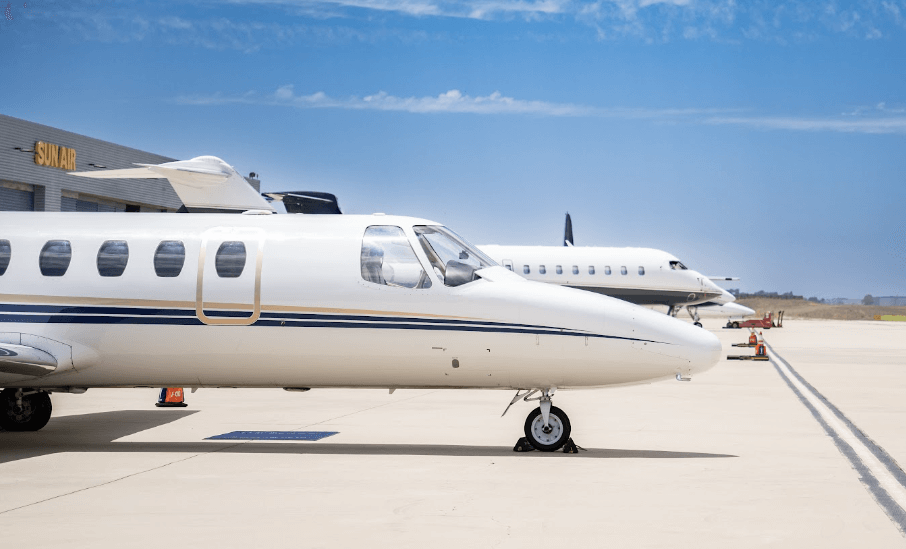
For decades, private aviation in Southern California, particularly flights departing from the bustling Van Nuys private jet VNY hub, has been synonymous with two core benefits: privacy and speed. When a client books a Gulfstream charter Los Angeles, these two “basics” are universally expected. They are the initial drivers for the shift away from commercial terminals.
However, the landscape of high-end travel is rapidly evolving. For the modern luxury traveler—who may be a Fortune 500 executive, a global entertainer, or a discerning family leader—these foundational elements are no longer sufficient. Simply being private is not the differentiator; it is the certainty of safety and the intricacy of personalized service that truly set a premier operator apart.
Today’s discerning clients demand an unparalleled level of service and a depth of safety assurance that requires a meticulous, operational-level commitment. Privacy and speed are merely the entrance fee to the game. Winning the loyalty of this clientele requires diving deep into the microscopic details that define a custom-tailored experience.
There are three key differentiators that have transitioned from “nice-to-haves” to non-negotiable standards for a premier Los Angeles charter operator.
1. The Operational Standard: IS-BAO Stage 3 Safety Rating
Safety is the cornerstone of all aviation, yet the certainty of safety exists on a spectrum. While all air carriers in the United States must meet the stringent standards set by the Federal Aviation Administration (FAA), premier operators understand that minimum compliance is not enough for the global elite.
For a true luxury provider, safety cannot be passive; it must be a deep-rooted, proactive culture. The gold standard for measuring this cultural commitment is the International Standard for Business Aircraft Operations (IS-BAO). This registration, granted by the International Business Aviation Council (IBAC), is not just a certification but a multi-stage, multi-year progression that evaluates the effectiveness of an operator’s Safety Management System (SMS).
While many operators can claim an SMS, only the elite reach IS-BAO Stage 3. This rating signifies that the operator’s safety culture is fully integrated, sustainable, and capable of identifying and mitigating risks before they ever materialize. At Stage 3, safety is not just a checklist; it is the instinctive behavior guiding every decision, from scheduling maintenance to crew training and flight planning.
This level of operational maturity is a non-negotiable for clients who understand that the real luxury is the peace of mind knowing that every flight operation, especially on a heavy jet like a Gulfstream charter Los Angeles, adheres to a standard that often exceeds that of major commercial airlines.
2. The Emotional Standard: Customized, Pet-Friendly Travel Policies
For many high-end travelers, “family” extends beyond humans to include beloved pets. Historically, pet travel was a logistical nightmare involving stressful car travel or, worse, checking an animal in the cargo hold of a commercial aircraft—a process fraught with anxiety and significant risks.
Today, true luxury operators recognize that the comfort of every family member is essential. This has elevated the need for genuine, compassionate pet-friendly private jet Los Angeles services.
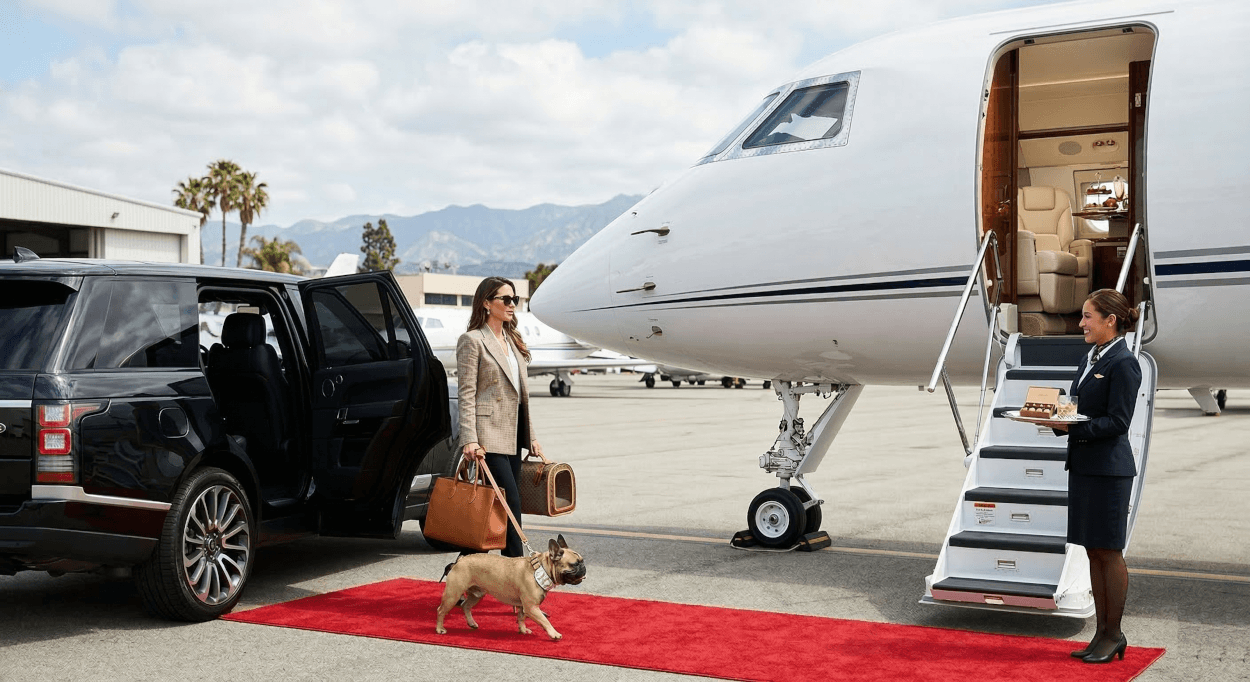
This standard goes far beyond “pets allowed” or simply accepting a dog in a carrier. It means having an operational policy that treats pets as passengers. It encompasses the availability of specialized safety equipment (like approved restraints), the understanding that pets may roam free in the cabin when safe to do so, and even the coordination with FBOs at hubs like Van Nuys private jet VNY to facilitate seamless boarding for four-legged companions.
A customized pet policy addresses details like pet-specific catering (yes, your dog can have a grilled steak or artisanal biscuits), pet concierge services that assist with local health regulations at the destination, and crew training on handling various animals with care. When an operator can flawlessly execute the logistics for a pet, they demonstrate that they are listening to the emotional needs of their client, turning what could be a stress point into a moment of pure comfort.
3. The Personalization Standard: Personalized Luxury Amenities from Catering to Specific In-Flight Requests
The final, and perhaps most visible, differentiator lies in the realm of personalization. A premier LA charter operator must move beyond standard offerings to a world where every touchpoint is curated for the individual.
Standard luxury jet charter LA amenities include high-quality linens, premium noise-canceling headphones, and perhaps a selection of magazines. But these are just table stakes. True luxury is an extreme form of attention to detail that anticipates and fulfills a client’s wishes before they are even articulated.
This personalization begins with gourmet catering. The modern standard is not just “good food”; it is a restaurant-quality meal (prepared by an artisanal caterer, perhaps with Michelin stars) that perfectly respects dietary restrictions, cultural preferences, and the specific desires of each passenger. A flight might require a vertical tasting of Napa Valley Cabs for one traveler, while another requests only raw, vegan dishes prepared without garlic or onions. The ability to source, prepare, and perfectly present these specific requests, especially in the unique environment of a business jet galley, is a hallmark of an elite operator.
Personalization extends to the atmosphere itself. True luxury jet charter LA amenities include the ability to tailor everything from the lighting schemes and cabin temperature to the exact brand of essential oil used in the diffusers. It means having a crew that has reviewed a guest profile and knows that “Passenger 3” always requires a certain kind of bottled water at their seat, “Passenger 2” needs extra-firm pillows, and the group will likely want high-speed streaming capability for the entire trip.
Whether it’s fulfilling a last-minute request to have specific flowers placed in the lavatory, coordinating a specific color scheme for a child’s birthday flight, or having a favorite playlist ready on the sound system, these microscopic details are what elevate a journey from transportation to a unique, custom-tailored experience.
In the competitive world of Southern California private aviation, particularly when flying from a hub as busy as Van Nuys private jet VNY, simply checking the box on privacy and speed is no longer enough. To win and keep the trust of today’s high-end travelers, operators must embrace a deeper, more rigorous set of standards.
By committing to the structural rigor of an IS-BAO Stage 3 safety rating, honoring the emotional commitment of authentic pet-friendly private jet Los Angeles travel, and mastering the intricate details of highly personalized luxury jet charter LA amenities, operators differentiate themselves.
Ultimately, these three non-negotiables are about one thing: removing the burden of details from the client, allowing them to step on board their Gulfstream charter Los Angeles not just to fly faster, but to arrive refreshed, secure, and entirely on their own terms.
In the high-stakes corridors of Silicon Beach and the Financial District, time isn’t just money—it’s the ultimate competitive advantage. For decades, the gold standard for Southern California’s elite was fractional ownership. The allure of “owning” a piece of a tail number suggested a level of status and guaranteed access that seemed peerless.
However, as we move through 2026, a significant shift is occurring. The modern Los Angeles executive is increasingly trading the heavy anchors of long-term contracts and massive upfront capital for the nimble, pay-as-you-go model of on-demand charter. The question on the minds of many family offices and C-suite leaders is no longer “which jet should I buy a share of?” but rather: is fractional ownership worth it in a market where flexibility is the true luxury?
The Financial Reality: Unpacking the Hidden Costs
When evaluating fractional vs charter planes Los Angeles, the financial breakdown often reveals a surprising truth: the perceived savings of “ownership” are frequently swallowed by a sea of hidden fees and market volatility.
The Plane Charter Model: Transparent and On-Demand
On-demand charter operates on a straightforward “pay-as-you-fly” basis. In Los Angeles, the hourly cost private jet users can expect typically falls into predictable ranges. For instance, light jets often range from $4,000 to $6,000 per hour, while midsize cabins can run between $6,000 and $9,000. For those requiring transcontinental range in a heavy jet, the cost typically starts at $10,000 and scales upward based on the aircraft’s vintage and amenities.
The private jet charter cost LA travelers pay is inclusive. While fuel surcharges and landing fees at hubs like Van Nuys (VNY) or Santa Monica (SMO) apply, they are itemized and transparent. There are no monthly “management” bills for a plane that is sitting in a hangar in another state while you are in a boardroom in Century City. You pay for the time you are in the air, and not a penny for the time the aircraft is on the ground.
The Fractional Model: The Capital Trap
Fractional ownership looks affordable on the surface but contains massive “underwater” costs that many first-time buyers overlook. First, there is the acquisition cost. A 1/16th share of a midsize jet—which typically grants you 50 hours of flight time—can require an upfront investment of $500,000 to $800,000.
Then come the monthly management fees. Even if you do not fly a single mile in a given month, you may still owe $10,000 to $20,000 to cover pilot salaries, insurance, and hangar rental service. Finally, there is the residual value risk. When your five-year contract ends, the operator is required to buy back your share, but they often do so at a 20% to 40% loss compared to your purchase price. When you factor in this depreciation, your “low” hourly rate often doubles in reality.
Why Flexibility Trumps Ownership in 2026
Los Angeles is a city of diverse business needs. One day, a tech founder may need a light jet for a quick 45-minute hop to San Francisco for a pitch; the next week, they may need a Gulfstream G650 to take a full legal team to New York for a closing.
No Aircraft Class Restrictions
With fractional ownership, you are typically locked into a specific aircraft class. If you own a share in a Light Jet but suddenly need a Heavy Jet for a transcontinental flight, you must “trade” your hours at a disadvantageous exchange rate. On-demand charter allows you to select the perfect tool for the specific mission every single time. You aren’t forced to fly a large, expensive jet for a short trip, nor are you cramped in a small cabin for a long one.
Zero Long-Term Commitment
A typical fractional contract locks you in for a minimum of five years. For an executive in a fast-paced market, five years is an eternity. On-demand private jet charter offers the ultimate exit strategy: if your travel needs change next month, your financial obligation is zero. There are no “dead money” management fees and no penalties for non-usage. You remain liquid and agile.
Avoiding Blackout Dates and Peak Surcharges
Many fractional programs and private jet card programs come with “peak day” restrictions. During high-demand periods—think Coachella, the Super Bowl, or the December holidays—fractional owners may face limited availability or massive surcharges. Charter brokers, by contrast, tap into a global “floating fleet.” Because they aren’t tied to a single brand’s limited inventory, they can often find creative solutions even when the major programs are grounded.
The Middle Ground: Private Jet Card Programs
For those who want more consistency than a one-off charter but aren’t ready for the capital trap of fractional ownership, private jet card programs have become a popular compromise. These programs function like a prepaid debit card for the sky. You deposit a set amount—typically between $100,000 and $250,000—which locks in a fixed hourly cost private jet rate for a set number of hours.
While jet cards offer more predictability than on-demand charter, they still require you to tie up significant capital. In the current economic climate, many LA executives prefer to keep that cash in their own investment portfolios, earning interest, rather than letting it sit in a charter operator’s bank account. On-demand charter provides the same level of luxury without the six-figure deposit.
The Strategic Advantage of Local Hubs
Choosing the charter model also allows executives to optimize their ground time by selecting the most convenient airport for each specific trip. While fractional programs often have “preferred” FBOs that might not be convenient, a charter user can choose to depart from Van Nuys (VNY) to avoid the 405 freeway, or use Burbank (BUR) if they are coming from the studios.
This hyper-local flexibility ensures that the flight is working for your schedule, rather than you working around the aircraft’s home base. In a city where a ten-mile drive can take an hour, being able to choose your departure point is a luxury that fractional ownership simply cannot always guarantee.
The Shift Toward Asset-Light Aviation
The era of “ego ownership” in aviation is fading. Today’s Los Angeles executives are making the strategic pivot toward on-demand charter because it aligns with the modern business philosophy of “Opex over Capex.” By opting for the transparency of private jet charter cost LA rates, you maintain total control over your capital while enjoying the exact same—if not better—cabin experience as an owner.
You avoid the “timeshare” pitfalls of the aviation world and ensure that your travel remains as agile as your business strategy. In todays business world, the smartest way to fly is to pay only for the air you move through. Contact us today to learn more or would like to find out how Sun Air Jets can help your business.
Flying private means more control and flexibility, but even the best jets meet their match with certain weather conditions. Rain, wind, and storms all play a part in shaping flight plans and timing. Pilots respond to these challenges with detailed planning and steady nerves, always focusing on passenger safety and comfort.
Understanding how weather affects your flight helps you see the hidden effort behind each trip. The team’s job doesn’t stop when you step on board—skilled pilots and support crew track every change, working to handle delays and smooth out turbulence. Knowing how professionals deal with weather lets you appreciate the extra layer of care that comes with a private jet charter experience.
The Most Common Weather Challenges for Private Jets
Weather shapes every aspect of a private jet flight, from departure to landing. Smaller jets often feel these weather changes more than large airliners, making precise planning and quick thinking essential. Let’s look at some of the most common weather obstacles private jet pilots face and how they work around them to keep each journey safe and smooth.
Thunderstorms and Severe Weather Systems
Thunderstorms are one of the biggest threats to private jet operations. Their rapidly changing conditions can bring lightning, hail, and unpredictable turbulence. Flight crews often monitor storms from hours before departure to well into the flight. When it comes to storms, pilots don’t take chances—avoidance is the rule, not the exception.
The risks that thunderstorms pose include:
Lightning: A direct strike is rare, but not impossible. Sensitive electronics could be compromised, causing navigational or communication failures.
Hail: Can seriously damage an aircraft’s fuselage or engines in seconds.
Turbulence: Sudden, violent shifts in air movement can make even the most seasoned flyers uneasy.
Microbursts and downdrafts: Fast-moving, downward streams of air can threaten a plane during takeoff or landing.
Private jets, with their lighter build and lower cruising altitude compared to commercial airliners, can experience sharper jolts and more dramatic course corrections when faced with stormy skies. That’s why pilots often reroute or hold flights on the ground until storms have passed over travel corridors.
Turbulence and High Winds
Turbulence isn’t just about bumps—it’s about safety and comfort, especially on private jets which are generally lighter and more responsive than big airliners.
Strong winds can lead to several flight challenges:
Wind shear: A sudden change in wind speed or direction that can cause unexpected altitude loss near the ground—especially risky during takeoff and landing.
Crosswinds: Winds blowing perpendicular to the runway make for tricky landings, requiring skillful piloting to keep the approach steady.
Clear air turbulence: Occurs without visible warning, such as clouds, making it difficult to predict and avoid.
While turbulence rarely causes harm, it can disrupt comfort and, in rare cases, safety. Pilots use advanced weather radar and flight path planning, and often work closely with dispatch and traffic control to find the smoothest possible air. For more insight into how turbulence affects private flights, see Private Jet Turbulence: Everything You Need to Know.
Icing and Snow Conditions
Icing is a major concern for any aircraft, but private jets are especially sensitive due to their size and performance profiles. When freezing rain or heavy snow hits, ice can build up on wings, tails, or sensors, impacting lift, stability, and system accuracy.
Common hazards from icing and snow:
Ice buildup: Increases weight and drag, while decreasing lift, making takeoff and landing dangerous.
Frozen control surfaces: Hinders pilot control, especially at low speeds.
Obscured sensors and vision: Can cause critical flight data errors or limit visibility.
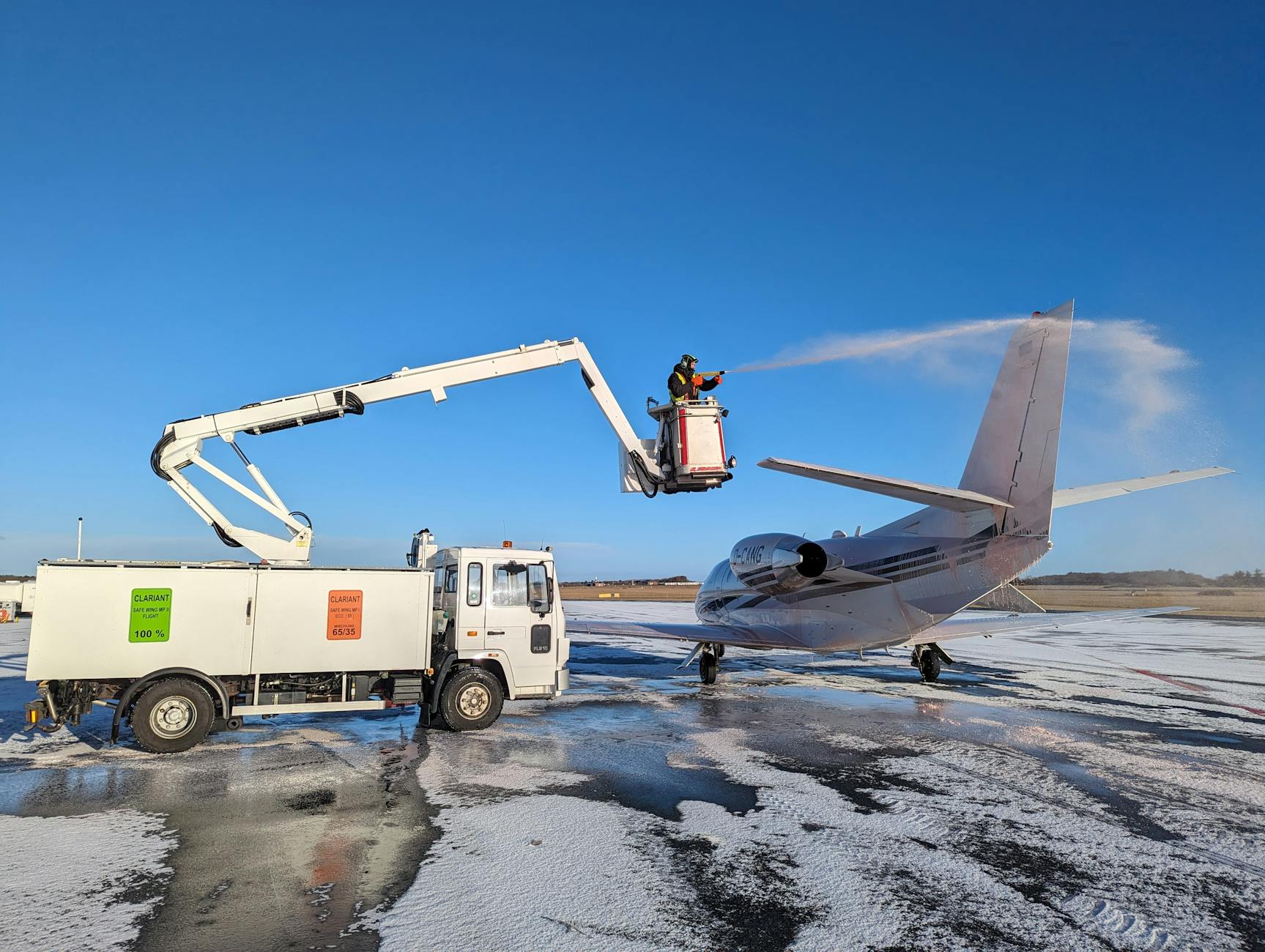
Ground delays for deicing are common in winter. Pilots follow standard protocols, such as applying anti-icing fluids or using on-board deicing systems, before and during flight to keep surfaces clear. In severe cases, private jets may need to wait on the ground or reroute to safer airports. For passengers, this means occasional delays, but always in the interest of safety first.
If you’re interested in learning how customized planning and flexible scheduling play a role during winter operations, check out how empty leg flights help operators manage shifting weather windows.
How Pilots Prepare for and Respond to Weather Challenges
Weather can change everything about a flight, from how long it takes to whether you’ll experience turbulence. Private jet pilots are trained to face these changes head-on, using a mix of technology, teamwork, and personal skill. Their actions start long before the engines roar to life and continue throughout the journey, keeping passengers safe and in the loop every step of the way.
Before a private jet leaves the ground, the captain and crew are already reviewing every weather detail. They check live radar, satellite images, and forecast models using powerful flight planning tools. With services like Sun Air Jets, advanced software compiles this real-time data, helping pilots compare hundreds of possible routes in seconds.
Pilots work closely with dispatchers who track weather on a national and global scale. This teamwork makes it possible to avoid threats like thunderstorms, turbulence, and icing before takeoff. The planning process involves:
Analyzing Current Conditions: Pilots look at radar, satellite, and meteorological reports along the planned path.
Predictive Forecasting: They use flight planning programs that calculate storm movement, wind shifts, and temperature drops.
Selecting Alternate Airports: Backups are always considered, especially if bad weather is expected at the destination.
Experienced crews also account for seasonal patterns, known trouble spots, and unique client requests. Modern jets, like those in the Sun Air Jets fleet, offer onboard weather radar and digital mapping displays, giving pilots the power to adapt fast. For more details about how leading operators use the latest tools, see how safety management systems support private charters.
In-Flight Decision Making and Passenger Communication
Once in the air, pilots don’t simply play a waiting game with the weather. They constantly monitor updates from air traffic control, onboard radar, and cockpit data links. When conditions shift — such as turbulence, storm build-up, or strong headwinds — pilots can:
Change altitude to find smoother air.
Reroute the plane to avoid storms or turbulence ahead.
Request priority landings or divert to alternate airports.
Good communication isn’t just for the flight deck. Pilots keep passengers up to date on what’s happening and why, especially if rough patches or delays are possible. A calm explanation — like why the jet needs to change course or fly lower — helps everyone on board relax. Passengers know their team is always looking out for comfort and safety, no matter what the sky throws at them.
Effective communication also strengthens trust in charter operators. The highest standards of service demand not only skilled flying, but also open and honest updates from the crew. For more on what makes private jet service stand out, visit what to expect from a private jet charter.
For those curious about how pilots hone these decision-making skills and what goes into real-time weather calls, check out this resource from the FAA about aviation weather decision-making for a behind-the-scenes look.
Passenger Experience: How Weather Affects Your Trip
When you book a private jet, comfort and timing are at the top of your list. But even with all the perks of private flying, weather can influence how your trip goes. From the moment you arrive at the terminal to the time you step out at your destination, weather plays a part in your overall experience. Knowing what’s possible helps set the right expectations—and lets you see all the ways your crew works to keep you comfortable and informed.
When the forecast looks challenging, your experience often starts with updates from your charter team. They’ll reach out early if there’s a risk of delay—sometimes before you’ve even packed your bags. Here’s what you might notice:
Clear Communication: Crew will keep you posted on potential weather delays and discuss options, like moving your trip later or switching airports if needed.
Flexible Scheduling: With private jets, you won’t be stuck on a rigid timetable. While delays are still possible, the team works to get you in the air as soon as it’s safe and comfortable.
Pre-Flight Comfort: Should you have to wait, luxury lounges make delays easier to manage. You can relax, work, or enjoy refreshments until your aircraft is ready.
Before departure, the crew also puts safety first by giving the jet a full check. They may request extra deicing, inspect for wind conditions, and review all systems related to passenger comfort. All of this happens behind the scenes so your journey starts off smooth.
Experience During the Flight: Comfort, Adjustments, and Arrival
Once in the air, weather can still play a role in your experience. Pilots have to make smart, sometimes quick, decisions to keep everything as relaxed as possible for you. What might this look like?
Smoother Rides: Pilots aim to avoid turbulence using weather radar and reports from other flights. If needed, they change altitude for a smoother ride.
Transparency: If a bumpy patch is ahead, your pilot will often let you know in advance, giving you time to get comfortable and secure loose items.
Luxury on Board: Private jets offer more tailored amenities—snacks, drinks, climate control, and entertainment—making any delay or change far more pleasant.
In rare cases, your crew may need to divert the flight to a different airport if landing conditions aren’t safe. If this happens, you’ll be supported every step of the way, with ground arrangements arranged quickly to keep your plans on track.
To dive deeper into the standards that keep you comfortable and protected no matter the weather, review Sun Air Jets’ private jet safety and operational standards.
The Balance of Safety and Luxury
The true difference of a top private jet service shows when weather interrupts your plans. Sun Air Jets quietly fuses safety measures with high-end comfort, so even a stormy forecast won’t leave you stranded or uncomfortable. From transparent updates to smoothly arranged alternatives, your journey reflects a blend of operational excellence and luxury. Every step centers on you—your time, your well-being, and your peace of mind.
With experience, quick thinking, and a commitment to great service, the whole team works together to turn unpredictable skies into a seamless travel experience.
Why Private Jets Offer Greater Flexibility During Inclement Weather
When storms threaten your travel plans, private jets stand out for their ability to adapt fast. Travelers who pick private aviation quickly learn how much more control and comfort they have—even when weather tries to get in the way. Flexible schedules, access to airports off the commercial grid, and the power to personalize every part of the journey combine to minimize disruptions that typically slow down airline passengers.
One of the biggest perks of private jets, especially in bad weather, is the ability to use thousands of airports that airlines can’t. If a storm grounds flights at a major hub, private jets can often reroute to a nearby smaller airport that’s still open and safe.
Advantages of this airport versatility include:
Skipping crowded airline terminals during delays or closures.
Shorter driving times on arrival, since you can land closer to your true destination.
Easier last-minute changes thanks to fewer restrictions and less congestion.
With more places to land, pilots find alternatives fast—often without a significant detour. This is especially helpful when winter weather or storms make popular hubs unusable.
Curious which airports you can access privately that airlines skip? Explore more about private jet airports and destinations to see just how many options you really have.
Flexible Departure Times
Rigid airline schedules put you at the mercy of changing weather, but private jets let you adjust your plans as needed. Operators will move your departure time to dodge incoming storms or delay just long enough for safe passage.
If a snow shower hits during your window, you might leave before or after to miss the worst of it.
Rather than getting stuck with a canceled flight, the crew will shift your trip to an available slot as soon as conditions allow.
This flexibility is a lifesaver during unpredictable seasons. It also means your day isn’t dictated by a single departure time and you avoid the stress of racing to an airport only to wait for hours. For a deeper understanding of how charter operators manage schedules, check out the benefits of on-demand private jet charters.
Personalized Service and Proactive Support
When the weather turns rough, a personal touch goes a long way. Private jet crews offer swift updates, suggest the best reroute options, and look after your needs from start to finish.
Here’s what sets private travel apart during weather delays:
A dedicated team monitors your trip in real time, adjusting plans for your safety and convenience.
Ground transport and connections are updated on the fly, so you’re never left stranded.
Your unique preferences shape every aspect—whether it’s providing a specific in-flight meal or arranging transport from a new airport.
This attention helps smooth out last-minute changes that weather often forces on commercial flights. If you want details about how tailored service can transform your travel experience, visit the page on what to expect from a private jet charter.
The Private Advantage in Weather-Related Disruptions
In the end, greater airport access, flexible schedules, and hands-on support give private jets a strong edge when storms hit. These features help keep you moving while others are stuck waiting. By choosing private, you gain a travel experience that adjusts to you, every step of the way—rain or shine.
For more perspective on how private aviation responds to diverse weather challenges, resources like NBAA’s article on winter operations for business aviation offer useful insights from industry leaders.
Conclusion
Every flight managed by skilled private jet pilots reflects their focus on safety and their talent for minimizing weather disruptions. With up-to-the-minute updates, smart planning, and a steady approach, they protect your comfort from takeoff to landing. You can feel confident that choosing private aviation means expert support even when conditions shift unexpectedly.
Rely on trusted operators like Sun Air Jets for your next trip—where adaptability comes standard and every detail reflects a commitment to smooth, secure service. Discover how their approach to private jet charter safety continues to set the bar for a reliable travel experience, no matter what the forecast brings.
The range of a private jet varies significantly by model. Light jets can travel up to 2,000 miles without refueling, making them perfect for shorter domestic flights. Midsize jets extend that reach up to 3,000 miles, comfortably covering cross-country routes. Heavy jets offer ranges of over 6,000 miles for international travel, enabling nonstop transatlantic and transpacific journeys with utmost luxury and speed.
If you are new to the world of private jets, you likely have many questions—especially since many different types of aircraft are available. How do you decide which one to charter, and will it reach your destination?
This article explores a common question from people interested in chartering a private jet: How far can a private jet fly?
Understanding Jet Categories: Light to Heavy
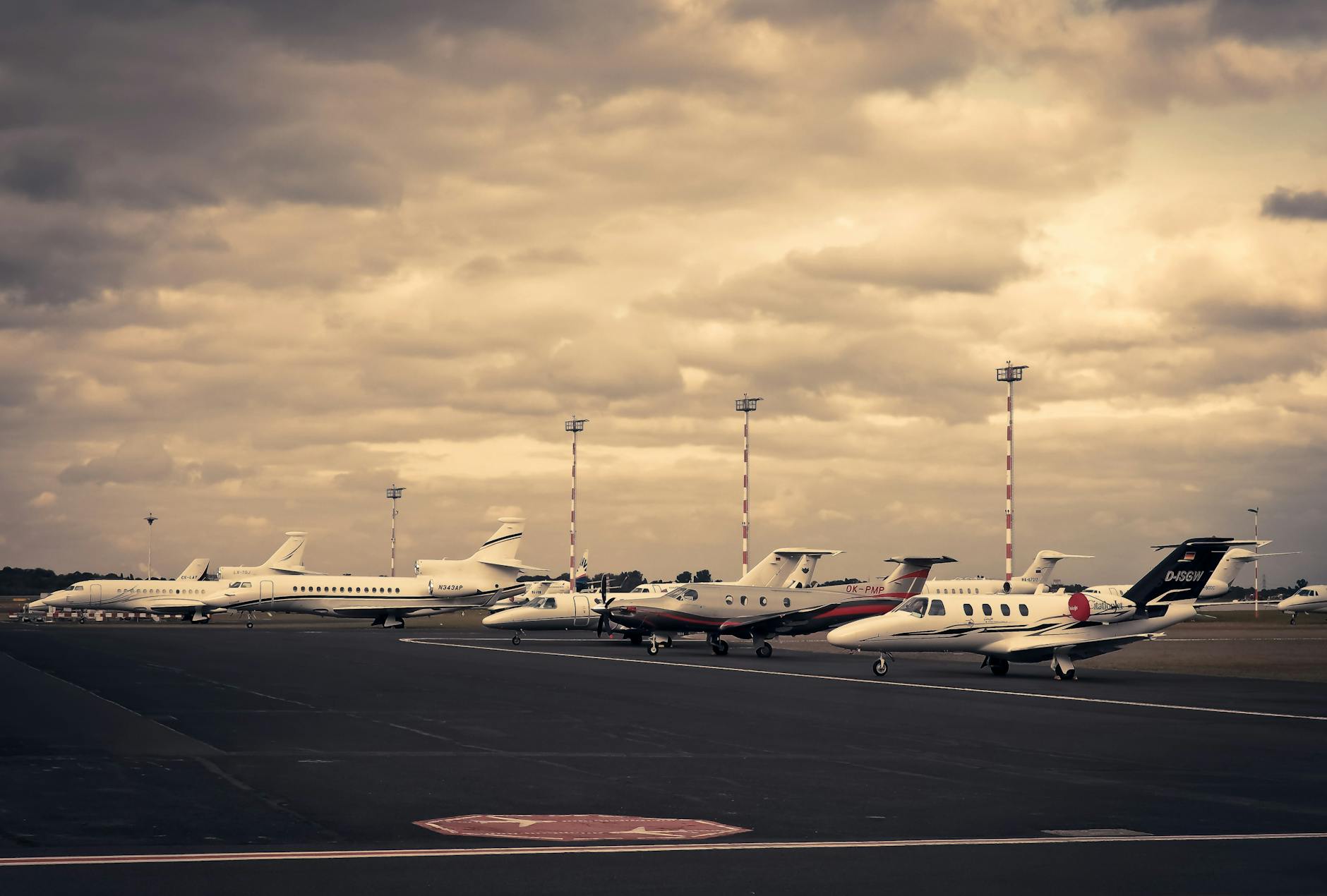
There are many aircraft in the sky at any given moment —- and they each look different. Even private jets come in different sizes with different capabilities and amenities. To help keep things organized and to avoid unwanted confusion, each jet belongs in a category from light to heavy, as follows:
Light jets
Midsize jets
Super Midsize jets (or super-mids)
Heavy jets
Ultra-long-range jets
Each of these categories has a set of characteristics that set it apart from the others. Keep reading to get a closer look at the specifics of these jet categories.
How Far Can a Private Jet Fly?
Private jets are renowned for their luxury, convenience, and flexibility, but one common question is: How far can a private jet fly? While private jets may not match the range of large commercial airliners, many models are capable of covering impressive distances, making them suitable for both short hops and long-haul flights. The range of a private jet depends on its size, design, fuel capacity, and engine efficiency. To better understand their capabilities, let’s break down the different categories of private jets and their typical ranges.
Private Jet Categories
Private jets are often categorized based on their size, capacity, and range. These categories help determine which type of jet is best suited for specific travel needs, whether it’s a quick regional trip or an intercontinental journey.
1. Very Light Jets (VLJs)
Range: 1,000 to 1,500 miles (1,600 to 2,400 km)
2. Light Jets
Range: 1,500 to 2,500 miles (2,400 to 4,000 km)
3. Midsize Jets
Range: 2,500 to 3,500 miles (4,000 to 5,600 km)
4. Heavy Jets
Range: 4,500 to 7,000 miles (7,200 to 11,200 km)
5. Ultra-Long-Range Jets
Range: 7,000+ miles (11,200+ km)
Factors That Influence a Private Jet’s Range
Several factors can affect how far a private jet can fly, including:
Fuel Capacity: Larger fuel tanks allow for longer flights, but they also add weight, which can impact performance.
Payload: The number of passengers, luggage, and onboard supplies can reduce the aircraft’s range.
Weather Conditions: Headwinds, turbulence, and temperature can impact fuel efficiency and range.
Altitude: Flying at higher altitudes can improve fuel efficiency and extend range due to thinner air and less resistance.
Speed: Flying at optimal cruising speeds maximizes fuel efficiency and range.
Light Jets: Short Hops Made Easy
Light jets are perfect for quick trips to regional destinations. You can benefit from this efficient travel so that you can make the most of your time.
While the range and passenger count will always vary based on the jet’s specifications, on average light jets have a range of 1,500 to 2,000 miles and have room for about 5 to 6 passengers comfortably. These jets come with their own set of amenities that cater to those going shorter distances.
Cruising speeds are usually between 400 and 450 mph.
Midsize Jets: Cross-Country Comfort Flights
Midsize jets are the most popular category of private charter jets. They are larger than light jets and often have room for about 10 passengers. As for range, you can expect them to range from about 2,000 to 3,000 miles.
Two pilots are required for these jets, and the inflight entertainment and amenities make the flight more comfortable.
Cruising speeds are usually between 450 and 480 mph.
Heavy Jets: Spanning Continents Without Stops
Heavy jets are large business jets. They have extensive amenities and luxuries throughout the cabin, and there is often room for 10 to 18 passengers.
Heavy jets range about 6,000 miles or more with cruising speeds usually between 480 and 560 mph.
Ultra-Long-Range Jets: The Ultimate in Aviation
Ultra-long-range jets are ideal for intercontinental travel. They are often very customized for your comfort, offering the ability to conduct business, dine, entertain, or sleep while onboard — with many having a configuration for each.
These jets go above and beyond anything you can imagine, reaching a range well over 6,000 miles and cruising speeds of usually 575 mph.
Factors Influencing Flight Range: Speed, Weight
Several different factors influence your fight range, including the speed you are traveling and your weight. Let’s take a closer look.
The weight of the aircraft directly affects its ability to travel. Carrying heavier loads requires more energy to move the jet. Passengers, luggage, fuel, and cargo are all included in this load when calculating distance.
Speed also plays a role. Each aircraft has an ideal cruising speed to be the most fuel-efficient. Not flying at speeds within this range will impact the aircraft’s fuel flow, drag, and, ultimately, range.
A few other factors that may impact just how far your jet can travel include:
Certain weather conditions, such as strong headwinds or poor flying conditions
Fuel capacity as the amount of fuel a jet can carry will determine how far it can travel
The efficiency of the engine since more modern engines tend to be more efficient
Maximizing Range: Tips for Longer Journeys
One of the perks of booking a charter jet is that you can save time by avoiding layovers or connecting flights. Instead, you can always fly nonstop to your destination.
Below are a few tips for longer journeys to ensure that your chartered private jet can go the distance.
Always choose the charter jet that can best handle the distance to the destination.
Reduce the weight on the aircraft, including the number of passengers and the amount of luggage.
Fly at higher altitudes to get better fuel efficiency.
Optimize the route to account for weather and winds.
Finally, if stopping for fuel is necessary, always refuel at a private airport, as they seem more efficient at getting you full and back in the air.
Charter a Private Jet with Sun Air Jets
You need a private jet that can get you to your destination. Sun Air Jets has a charter fleet capable of meeting a wide range of travel needs and a private jet charter services team that ensures you will find the perfect jet and personalized experience.
You can feel confident that you will maximize your time, enjoy all the luxurious amenities, and reach your destination when you charter a private jet to any destination with Sun Air Jets.
Conclusion
There are many different private jets available for your next getaway.
Ready to see how far a private jet can fly? Book your next charter with Sun Air Jets.
Private jets often fly faster than commercial airliners, offering speeds surpassing those of their commercial counterparts. This speed advantage, combined with the ability to use shorter routes and less congested airports, enables private jets to provide quicker door-to-door travel times. Private jets often cruise at higher altitudes, where less air traffic and more direct routes further reduce travel time.
Are private jets faster than commercial planes? If you have ever traveled on a private jet, then you know they are fast and efficient — two words rarely used to describe a commercial air travel experience. Aside from having a nonstop flight that will not require you to deal with a layover, it feels like you get to your destination faster. But is it really because of the jet’s speed?
Let’s look at what makes private jets faster than commercial planes.
Are Private Jets Faster than Commercial Planes?
When it comes to air travel, speed is a significant factor in determining how quickly you can reach your destination. But does flying on a private jet get you there faster than a commercial plane? The answer isn’t as straightforward as it might seem, as several factors come into play when comparing the two.
Speed Comparison: Private Jets vs. Commercial Planes
Private jets are generally faster than commercial airliners. On average, private jets cruise at speeds of around 600 miles per hour, with some models capable of reaching top speeds of up to 700 miles per hour. For example, the Cessna Citation X, often regarded as the fastest private jet, boasts a top speed of 711 miles per hour. This makes it one of the fastest civilian aircraft in the world.
In contrast, commercial airliners typically cruise at speeds of about 500 miles per hour. While this is still impressive, it is notably slower than the average private jet. For instance, a Boeing 747, one of the most iconic commercial planes, has a cruising speed of approximately 570 miles per hour, which is still below the top speeds of many private jets.
Why Are Private Jets Faster?
Several factors contribute to the superior speed of private jets compared to commercial planes:
Weight and Size:
Private jets are significantly lighter and smaller than commercial airliners. They carry fewer passengers, less cargo, and are constructed using lightweight materials such as titanium and aluminum. This reduced weight allows them to accelerate more quickly and maintain higher speeds with less effort.
Altitude:
Private jets typically fly at higher altitudes than commercial planes. At these higher altitudes, the air is thinner, resulting in less air resistance. This enables private jets to maintain faster cruising speeds more efficiently. Commercial planes, on the other hand, often fly at lower altitudes due to their size and the need to accommodate more passengers and cargo.
Faster Climb to Cruising Altitude:
Private jets can reach their optimal cruising altitude much faster than commercial planes. This means they spend less time ascending and descending, allowing them to maintain their top speeds for longer periods. Commercial airliners, due to their size and weight, take longer to climb and descend, which can slightly reduce their overall efficiency.
Flexibility in Flight Paths:
Private jets often have more flexibility in choosing their flight paths. They can take more direct routes and avoid congested air traffic, which can further reduce travel time. Commercial planes, however, are often restricted to specific flight paths and must adhere to strict schedules, which can sometimes result in longer travel times.
Efficiency and Practicality
While private jets are undeniably faster, it’s important to consider the broader context. Commercial planes are designed to carry hundreds of passengers and large amounts of cargo, making them more practical for mass transportation. Private jets, on the other hand, are tailored for smaller groups or individuals who prioritize speed, convenience, and privacy.
Additionally, private jets can access smaller airports that are closer to final destinations, reducing the time spent on ground transportation. This can further enhance the overall efficiency of private jet travel, especially for business travelers or those with tight schedules.
The Weather and the Speed of a Private Jet
Weather can play a significant role in the speed of a private jet.
Winds. When going against the wind, unwanted resistance and drag can cause the aircraft to slow down and may extend flight times. This is known as headwinds. On the other hand, tailwinds are a favorable wind that helps push the aircraft along, decreasing flight times.
Temperature. Great weather and ideal temperatures yield the best opportunity for excellent flight times. However, when the temperatures turn extreme they become another variable that can impact the speed of a private jet. Here’s why — in hot temperatures, the aircraft’s engine will have to work harder. In extremely cold temperatures, private jets have to deal with the buildup of ice which can weigh down the jet. Both situations can slow down a jet.
Dangerous weather. Keep in mind that when weather is out of control with storms or winter weather, many flights will remain grounded to protect the safety of the passengers and the flight crew. This holds true for both private jets and commercial planes. The difference is that once it is safe to do so, private jets will take off — while commercial airline travelers may have to wait for another flight.
Private Jets Save You Time
Aside from speed, private jets save you time when you look at the greater picture.
Commercial air travel comes with a lot of waiting. It requires you to arrive early, stand in security lines, and wait around for your flight. It also comes with a lot of delays and cancellations, too. Because commercial airliners use pre-determined flight schedules and patterns, you may even find yourself having to change planes (potentially involving a long layover) just to get to your destination.
With private jets, you save time. You don’t have to worry about long lines or long waits. What’s more, you get to choose when and where you want to travel and choose a private jet that will get you there without having to stop.
All of this helps private jets to be faster than commercial planes.
Get Where You Need to Go with Sun Air Jets
Sun Air Jets offers private jet charter services that allow you to get where you need to go faster than a commercial plane. But our charter team knows that it isn’t just about speed, is it? Our world-class service enhances your travel plans from the moment you book your flight.
On the day of travel, you will only need to show up about 15 to 20 minutes before your flight. You will walk through a quick security check and go to your jet, where your flight crew will await you.
Once onboard, you will be surrounded by all the luxuries and amenities of private travel with Sun Air Jets. From complimentary wifi and inflight entertainment to plush seating and personalized dining, we know how to make your trip successful.
There are no long lines or waits – just speedy, comfortable travel.
Conclusion
Are you ready to book your next getaway? Contact the charter team with Sun Air Jets to make it happen — and have more time to enjoy your destination. After all, private jets travel faster than commercial planes.
Private jets don’t typically go through standard TSA security checks like commercial flights, but alternative measures ensure passenger safety.
When it comes to air travel, many of us are familiar with the rigorous security checks at commercial airports. But what about private planes? Do they go through the same TSA procedures? The answer isn’t as straightforward as you might think. Private planes operate under a different set of regulations overseen by the Federal Aviation Administration (FAA), not the Transportation Security Administration (TSA).
The TSA, established after the 9/11 attacks, is tasked with ensuring the safety of commercial flights by meticulously screening passengers, baggage, and cargo. While private plane passengers generally bypass these rigorous TSA screenings, they aren’t entirely exempt from security protocols. The level of security depends largely on the type of private aircraft and specific airport policies. So, while flying privately offers a unique experience, it doesn’t completely eliminate the need for safety measures. Understanding these differences can help demystify the world of private air travel.
What is TSA?
The Transportation Security Administration (TSA) is a US government agency dedicated to securing the nation’s transportation systems. Created after the September 11, 2001, attacks, TSA focuses on ensuring the safety of air travel by reducing security threats and illegal activities at airports.
What is the Role of TSA at Airports?
TSA’s primary role at airports is to screen passengers, baggage, and cargo to prevent prohibited items from boarding aircraft. They use advanced technology like x-ray machines and body scanners, alongside manual inspections and pat-downs, to detect threats. By enforcing strict security protocols, TSA staff maintain order and safety within airport facilities. TSA collaborates with airport authorities and law enforcement to promptly address potential threats, ensuring a secure environment. Additionally, TSA plays a crucial part in installing and managing security checkpoints, providing training for staff, and conducting background checks to enhance overall security.
What Security Measures Are in Place for Private Jets?
Private jets have specific security protocols. Background checks vet passengers for potential risks. Security personnel, often trained for private aviation, oversee airport and aircraft security. Baggage screening, though less rigorous than TSA procedures, ensures prohibited items don’t make it onboard. Flight manifests list passenger names, and secure facilities house private terminals with advanced surveillance. These measures, along with customs and immigration checks, maintain a safe environment.
Do Private Jet Passengers Need to Go Through Metal Detectors?
Private jet passengers generally don’t pass through metal detectors. Fixed Base Operators (FBOs) use alternative security methods like bag checks and identity verification. Due to smaller groups of pre-screened travelers and lower perceived risks, metal detectors aren’t standard. However, background checks and luggage inspections provide a tailored security experience.
Why Don’t Private Jets Go Through TSA?
Private jets bypass TSA screenings by following their own security protocols. This ensures both efficiency and privacy for travelers on these aircraft.
Is there a Difference in Security Standards for Private Jets?
Security standards for private jets differ from those of commercial airlines. Unlike commercial flights, private jet passengers don’t face TSA checks. Passengers undergo a distinct process with operators handling identity verification and security measures. This method streamlines boarding while maintaining safety, even with fewer passengers. Operators collaborate with security agencies to ensure compliance with aviation rules.
What Other Security Measures are in Place for Private Jets?
Private jets employ various security strategies to protect against threats. Restricted access to terminals ensures no unauthorized entry. Passengers and crew undergo rigorous background checks, while bag screening prevents prohibited items from boarding. Security personnel at terminals monitor activities, addressing potential threats promptly. Additionally, identity verification is required before boarding a flight. Advanced security systems, like surveillance cameras, enhance terminal safety. These targeted measures ensure passengers’ safety, reflecting the industry’s commitment to secure travel.
The Advantages of Flying Private
Flying private offers a more seamless and convenient experience than commercial airlines. Passengers avoid TSA screenings, enjoy VIP service, and benefit from a stellar WiFi signal. Confidentiality is prioritized, so there are no concerns about prying eyes or ears. Passengers control multiple aspects of their experience, from departure times to travel companions, allowing for schedule flexibility.
Customization and Flexibility
I find immense benefit in flight customization. Passengers choose everything from the flight menu to seating arrangements. These options allow passengers to tailor the journey to their needs and preferences, making the experience unique. Moreover, flexible schedules mean last-minute changes are accommodated, keeping stress to a minimum.
Privacy and Comfort
Privacy on a private jet means it’s easy to conduct meetings or relax without disturbance. I appreciate the company’s comfort, as only invited travelers accompany me. Ample seating and cabin space add to the luxury, transforming the flight into a more pleasurable experience.
Productivity Boost
Without the distractions common in commercial flights, productivity improves. Passengers who work en route can focus, complete tasks, and maintain privacy. This feature often leads to more efficient use of travel time, which I value during tight business schedules.
Time-Saving
Private jets typically fly higher than commercial counterparts, reducing travel time by avoiding busy air traffic and unfavorable weather. Direct routes further enhance speed, taking passengers to destinations faster. These features exemplify how private travel emphasizes time efficiency.
Safety and Security
Private jets are as safe as commercial ones, adhering to FAA regulations. Although TSA procedures aren’t standard, private aviation employs alternative measures. Passengers undergo background checks, and security personnel monitor flights, ensuring safety without extensive screening.
Amenities on Private Jets
Private jets offer an array of luxurious amenities designed to enhance the travel experience. Attention to detail in comfort and efficiency distinguishes private flights from commercial travel.
How Does Flying Private Work?
Flying private allows passengers to set their schedules and choose airports, reducing travel time. Operators arrange everything from pre-flight check-ins to in-flight services, ensuring a seamless journey.
Are Private Jets Faster Than Commercial Jets?
Yes, private jets often reach destinations quicker than commercial flights. They fly direct routes, bypass crowded airspaces, and utilize smaller, less busy airports, reducing delays.
Are Private Jets Safe?
Private jets maintain high safety standards. Operators prioritize aircraft maintenance and follow strict safety protocols, ensuring a secure travel environment.
Do Passengers on Private Flights Go Through TSA?
Passengers on private flights generally bypass standard TSA screenings but undergo specific security measures like identity verification and baggage checks, managed by Fixed Base Operators (FBOs).
What Can You Bring on Charter Jets?
Charter jet passengers enjoy fewer restrictions on luggage, allowing personal convenience items onboard, including liquids and pets, enhancing travel comfort.
Can Private Jets Land Anywhere?
Private jets can land at most airports, including smaller regional ones. This flexibility enables accessibility to remote destinations and reduced travel times.
Can You Use Electronics on a Private Jet?
Passengers can use electronics during their flight. Private jets provide WiFi and satellite phone services, facilitating communication and work.
Do You Need a Passport or Visa on a Private Jet Flight?
Passport and visa requirements on private jets depend on international travel regulations. It’s important to ensure documentation is in order when flying across borders.
Is Food Served on Private Flights?
Yes, private flights offer personalized catering. Passengers can request specific meals, ensuring a tailored dining experience to suit preferences.
Airplane Access
One more component of going through security screening that is different when you fly privately is that you often get selective admittance to the runway. Sometimes, you don’t even need to go to the airport terminal because many private airports permit you to drive straight up to your private plane.
Since you don’t have to go through the terminal or line up with the crowd, you can show up at your airplane at the time of takeoff instead of hours in advance. Fly as soon as you and your flight crew are ready.
Customs
Since flying private doesn’t mean you can skip customs while arriving at an international destination. All international rules still apply to private jet travelers, from limitations on what you may bring into the country to prerequisites for proper identification proof, visas, and passports.
The only difference is that you may have access to a private customs area, which permits you to avoid lining up with many travelers. You will still meet with customs authorities, yet it will be a significantly more facilitated process than if you were flying commercial.
The flight crew is not exempt from these requirements as their travel documents and luggage are inspected. And although security and customs measures are still required, a private charter is a better option for speed and convenience when traveling domestically and internationally.
Selecting the right aircraft for business travel can transform your time out of the office from the moment you step into the cabin. The Gulfstream G200, the Citation X, the Citation X Elite, the Hawker 900XP, and the King Air 350i all provide you with a superior travel experience. Each comes with a long list of luxurious amenities, comfortable surroundings, and inflight connectivity.
Traveling for business usually requires you to promptly get where you need to be – while allowing you to make the best use of your time in the sky. This means you need a dependable and efficient jet with inflight connectivity.
With so many business jets available in different sizes and with all types of capabilities, how do you know which one will meet your travel needs?
This article explores the most efficient aircraft for business travel.
Efficient Aircraft for Business Travel
There are a few jets that are efficient and ideal for business travel, including those that provide the perfect combination of luxury, comfort, and amenities. So, whether you want to take a nap to feel refreshed when you land or you want to do some work to prepare yourself for a business meeting, you will find it easy to do on a chartered jet.
Here are some of the most efficient aircraft for business travel.
Gulfstream G200
The Gulfstream G200 brings together sophistication and performance. It has the power to get you where you need to go quickly — and, with a range of 3400 nautical miles, it can go the distance, too.
Are you traveling for business with a group? This is one of the best aircraft for business travel, with a spacious interior and room for 10 passengers.
As for the features of the Gulfstream G200, it has 2 large LCD bulkhead monitors and an Airshow 4000 DVD/CD, a full-service forward galley to keep you and your guests satiated, and a lavatory with full vanity. What more can you ask for?
Comfortable seating with retractable tables makes it easy to get work done when you need to so that you are prepped and ready to go as soon as you land.
Citation X
The Citation X is one of the most popular business jets in the business jet category. Perhaps it is because it is one of the fastest midsize aircraft ever made. So, if you are looking for efficiency, you will find it here.
What’s more, the Citation X has a good range of travel — 3100 nautical miles. That’s perfect for getting you from Los Angeles to New York without stopping to refuel. No layovers here!
Once onboard, up to 8 passengers can take advantage of entertainment features like complimentary domestic wifi, Aircell Iridium flight phone, DVD/CD entertainment system, and a full-screen LCD monitor. You can handle business or take some time to enjoy yourself while on the flight.
The galley has a refreshment area with a microwave and coffeemaker, as well as a full lavatory for convenience. All of this comes together to make your trip more enjoyable no matter how far you are traveling.
Citation X Elite
As if the Citation X wasn’t already one of the greatest aircraft for business travel, the Citation X takes it a step further. With a factory upgrade, this jet has been enhanced for pilots to have improved control and more in-depth weather systems. This jet is still fast and packs a powerful performance so that you can travel near or far as efficiently as possible.
Like the other, it still has room for 8 passengers in a club seating setup with retractable tables. You can stay productive and fully connected with those on the ground with the help of internet access and inflight phones.
Want to arrive refreshed? The nighttime configuration can allow you to sleep comfortably inside the cabin or relax with your seat reclined.
Everything you need is at your fingertips on this jet — don’t miss out.
Hawker 900XP
The Hawker 900XP has a range of 2800 nautical miles or a total of 5.5 hours. It has room for up to 8 passengers who can move easily around the spacious cabin with five chairs and a couch. Again, retractable tables allow you to have a comfortable space to get business done while in the sky.
This jet also comes with 2 large monitors and a blue-ray/DVD entertainment system to keep you entertained when you need a break from work. Business travelers can also take advantage of a full forward galley and lavatory with full vanity, too.
King Air 350i
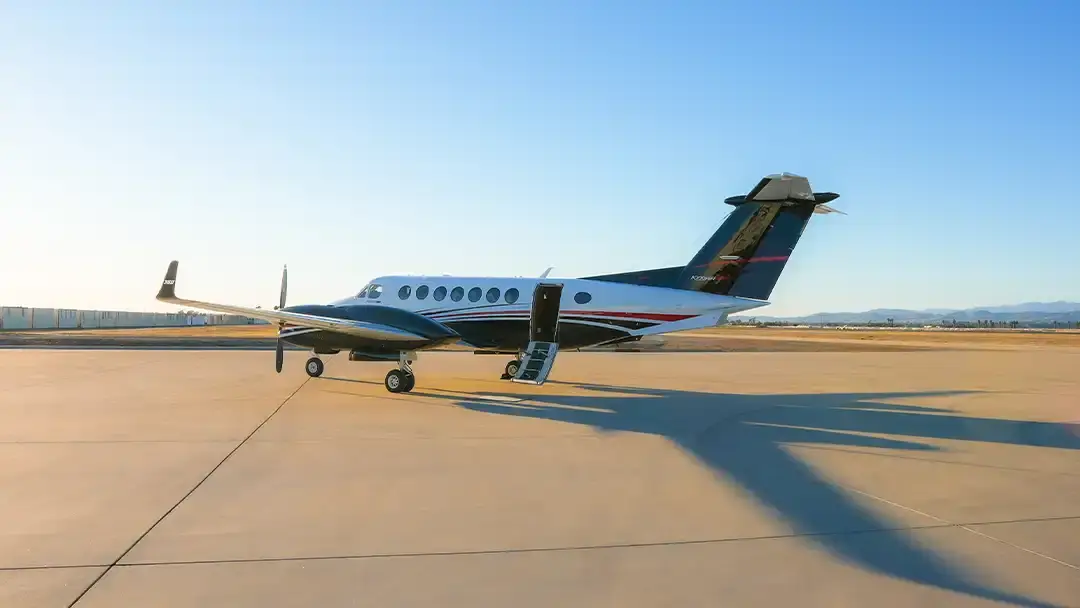
The King Air 350i is another one of the perfect aircraft for business travel for short travel – about 1800 nautical miles. The double club seating for 8 passengers allows the space to feel open while still making it easy to remain social with everyone on board.
The seating is very comfortable and the surroundings feel open and bright thanks to the 14 windows that line the sides of the cabin.
For business travelers, storable worktables and convenient power outlets can help you remain productive without sacrificing comfort.
You can also take advantage of refreshment centers and a private enclosed lavatory.
It’s a fast, efficient private jet when you need it.
Charter a Private Jet Today
Traveling can mean extended time out of the office — leaving you with work obligations untouched. If you have upcoming business travel, why not make the best of your trip with one of the most efficient aircraft for business travel available?
Sun Air Jets offers a large charter fleet, including aircraft for business travel to get you where you need to go in comfort while staying connected with your office and maintaining your level of productivity.
Business travel doesn’t have to be frustrating. Rather, it can be efficient, luxurious, and comfortable.
When you have to take to the sky for your business trip, remember that aircraft for business travel make a world of difference in your overall experience.
Miami may be at the southern tip of Florida, but it is not out of reach for the Gulfstream GIV-SP. Wherever you are traveling from, this private jet will get you there to enjoy the best Miami offers, like gourmet dining experiences, outdoor water fun, luxurious accommodations, and various other activities. Then relax from your adventure on the Gulfstream GIV-SP all the way home.
The sunshine is on in Miami, and the adventures await you. But, depending on where you are traveling from, the flight can be long and come with connecting flights and long layovers. When you charter a flight aboard a private jet, you save time and maximize your time in The Magic City.
This article explores why you should charter the Gulfstream GIV-SP for your next trip to Miami, Florida.
Soak Up the Sun in Miami with the Gulfstream GIV-SP
Miami is known for its tropical climate, beaches, vibrant nightlife, and diverse cultures. It’s a melting pot of ideas, adventure, and class. Why wouldn’t you want to show up in style?
Here’s why you should charter the Gulfstream GIV-SP for your next trip to Miami.
Why Visit Miami, Florida?
Miami is a top vacation spot for Americans and travelers worldwide. It offers beaches, endless art galleries, trendy nightlife, luxurious hotels, high-end shops, and world-class dining.
So, why visit Miami, FL? It is nearly impossible to list all the reasons why you should fly into this city. But here are a few reasons you should book your charter and come.
Beaches that are accessible year-round. With the climate, you can expect the sun to shine, even after a rain shower. The sand is always white, and the beaches are always blue and inviting.
Art is found on nearly every corner, whether on the side of a building, the architecture of the building itself, or in one of many galleries.
Here are a few additional reasons:
The nightlife and club scene has been booming for decades
The food has been influenced by ethnicities far and wide
Spend time on the water, in the water, and by the water
Pristine golf courses are waiting for you
And did we mention that the shopping never ends?
Experience the Luxury of Gulfstream GIV-SP
The Gulfstream GIV-SP has room for 13 passengers — and sleeps 6. It was remodeled in 2016 to have all of the modern amenities and luxuries that will elevate your travel. Comfortable seating, a full galley, and a lavatory with full vanity all add to the overall experience.
Aside from the private surroundings, you can enjoy the complimentary domestic wi-fi, Gogo Vision Inflight entertainment system, full-screen LCD monitor, and eight power outlets.
There is no shortage of what you can do on this spacious, elegant jet.
Top Activities in Miami
While the beach is usually on the top of tourist lists when visiting Miami, it isn’t the only thing to do.
Vizcaya Museum & Gardens is a popular spot. A waterfront estate home, it has formal gardens and 32 rooms for you to explore. Tours and events of the grounds promote environmental sustainability and cultural vitality.
Art is huge in this city. Visiting galleries and checking out the art throughout Wynwood is something everyone should do. There are all types of influences and creations for everyone to enjoy.
Bayside Marketplace is an open-air shopping and dining destination. Shows and events also take place here throughout the year — you never know what you may get the opportunity to experience.
Luxury Accommodations in Miami
Before you arrive in Miami, you want to make sure you have your accommodations reserved. Some of the most luxurious resorts can be found in South Beach, Coconut Grove, Doral, and Coral Gables.
You will have access to luxurious amenities, private beaches, golf courses, exquisite dining, and high-end shops. Of course, we cannot forget the spas, too.
A few to consider include W Miami, Mandarin Oriental Miami, Four Seasons Hotel Miami, The Setai in Miami Beach, and Faena Hotel Miami Beach.
Gourmet Dining Experiences
Miami is known for its diverse dining experiences. Each offers its own experience and delicious cuisine. Here are a few restaurants worth checking out while in Miami:
Carbone
L’Atelier de Joël Robuchon
Pastis Miami
Casadonna
COTE Miami
Boia De
The Surf Club
MILA Restaurant
Looking for a unique dining experience in Miami? Consider the following —
La Cumbancha for dining, dancing, and live music all in one
Prime 112 takes you back in time
Mangroves is a neat gem
Gramps Getaway in Wynwood where you’ll feel like everyone knows your name
There is a dining spot for everyone in Miami. You will find your favorite.
Outdoor and Water Activities
There are many things to do outdoors in Miami. The beach, of course, allows you to swim, go paddleboarding, skiing, scuba diving, fishing, and cruising. But did you know that it is also home to the Everglades? This protected area and its wildlife are thrilling to explore – especially on an airboat ride.
Strolling through one of the hundreds of parks, going for a bike ride, or simply just window shopping can keep you outdoors while you soak up the vitamin D in The Sunshine State.
Charter the Gulfstream GIV-SP Today
Aside from its powerful performance, there are many reasons to charter the Gulfstream GIV-SP. From its spacious interior to its onboard amenities and luxurious comforts, it is perfect for long-range travel to Miami.
Charter the Gulfstream GIV-SP with Sun Air Jets and get the most personalized experience onboard a private jet. Your trip to Miami will be nothing short of magnificent.
The Global Express for business travelers comes with a long list of features that are perfect for those traveling for meetings, retreats, or other work-related needs. Spacious cabins allow for spreading out (and sleeping). Advanced connectivity keeps productivity up while traveling. Privacy boosts confidentiality. Fast speeds for the long haul with a dedicated service crew make it the most ideal jet for business travel.
Private jets have a long list of features that can enhance your travel from one destination to another. Knowing what a jet offers and how it transforms the onboard experience can help you determine the best charter for your needs.
Traveling for business? This article explores the top features of the Global Express for business travelers.
The Top Features of the Global Express for Business Travelers
If business travel is necessary in the course of your work, then having all the right perks and amenities can make any trip more convenient and enjoyable. While any private jet can elevate your air travel, there is nothing quite as remarkable as the Global Express.
Here are the top features of the Global Express for business travelers.
Spacious, Versatile Cabin Layouts
When you step into this private jet, you will be surrounded by elegance and class. Spacious surroundings make moving about the cabin a breeze. And, with a cabin height of 6’3”, most can stand up straight without issue.
You will find plenty of seating for up to 12 passengers and six if you want to sleep. There are also 195 cubic feet of baggage capacity, a full galley, and two lavatories — one with a full vanity.
So no matter what you want to do while onboard the Global Express, you will have plenty of space to feel comfortable.
Advanced Connectivity for In-Flight Productivity
For decades, business travel meant being out of touch with the office from takeoff to landing. Today, however, things are different — especially onboard the Global Express.
Advanced connectivity will allow you to remain connected with those on the ground even when you are flying high above the clouds. You can prep for your meeting, get some work done, and even interact with those back in the office.
Maintaining productivity is the perfect way to use your downtime while in flight.
Superior Range for Long-Haul Travel
As its name suggests, the Global Express can travel globally, reaching about 5,900 nautical miles before needing to stop for fuel. When going the distance for business travel, it is most efficient to charter a jet that meets your expectations efficiently.
Time is precious so don’t waste it. Wherever you need to go, the Global Express will get you there in style and class.
Unmatched Speed, Efficiency
Speaking of time, the Global Express can not only travel far distances but at unmatched speeds, too — about 580 mph, on average. What’s more, it can reach a cruising altitude of about 37,000 to 42,000 quickly so you can expect a smooth flight no matter where your destination is.
Keep in mind that the speed of the jet will vary based on headwinds, capacity, and outside temperature. Despite all of these things, this jet will always be a fast, efficient way to travel for business — soaring above the competition.
Low Cabin Altitude: Enhanced Comfort
The Global Express was made for passenger comfort. So it is no surprise that the pressurization keeps the cabin altitude as low as possible. As a result, passengers experience the greatest amount of comfort imaginable on a jet.
To be more specific, the cabin pressurization maintains a 4,500 ft cabin altitude even when traveling 45,000 ft in the sky. How incredible! Whether you are getting some work done, watching a movie, or catching up on some sleep, you can do so comfortably on the Global Express.
State-of-the-Art Entertainment Systems
Don’t expect to get bored on the Global Express. There is always something to do and some way to stay connected. You will find:
Honeywell Ovation cabin entertainment system
GogoVision 360 entertainment
Three large LED monitors
Four personal monitors
USB charging power outlets at each seat
And, remember, you are always connected.
Privacy Features for Confidential Meetings
When traveling for business, there is sure to be talk of upcoming meetings, engaging with colleagues, or even just opening a laptop to tackle some work. Each of these things can put you at risk of breaking confidentiality when done in the air. That is, of course, as long as you are traveling with strangers.
The Global Express doesn’t even compare to commercial air travel. There are no strangers — and the privacy level is perfect for the most confidential meetings. You can feel comfortable speaking freely and openly, as well as using your laptop or opening files and documents within the cabin.
The only eyes and ears on board are yours and those you brought with you.
Dedicated Service Crew for Personalized Care
Travel on the Global Express comes with a dedicated service crew for personalized care. You need to have the most luxurious, pampered experience while onboard this private jet, and your crew is going to make that happen.
From small touches throughout the cabin to serving you drinks and refreshments when you want them, your service crew will be there to take your flight experience to the next level.
Charter the Global Express for Your Business Trip
You have to travel for business but don’t want to be unplugged or deal with the frustrations that tend to come along with air travel. What do you do?
When you charter the Global Express with Sun Air Jets you not only get a trip on a luxurious jet with plenty of amenities, but you also get the personalizations that come with a world-class charter team.
Don’t let your business travel get you down — boost your air travel experience and book the Global Express.
Conclusion
Comfortable seating, inflight entertainment, advanced connectivity, privacy, and more can be found onboard the Global Express. The list is even longer when you consider all the perks of flying private.
The Global Express for business travelers is exactly what you need for your next trip.
The number of people that can fit on a private jet varies depending on the aircraft model. Small jets typically accommodate 4-8 passengers, midsize jets 8-10, and large jets 10-18. For larger groups, ultra-long-range jets can seat up to 19 passengers, ensuring luxury and comfort for any travel need.
How many people can fit on a private jet? This is a common question among people interested in charting a private jet for their next trip.
Finding the right private jet to accommodate your group can be challenging, especially with varying aircraft sizes and configurations. Understanding the differences between jets can help ensure you avoid booking a jet only to discover it’s too small for your party or too large and costly for your needs.
This guide breaks down the capacities of different private jet categories, helping you choose the perfect aircraft for your travel needs.
How Many People Can Fit on a Private Jet?
Traveling on a private jet comes with a long list of benefits. And no matter how many passengers you have with you, you can still take advantage of them when you choose the right jet.
So, how many people can fit on a private jet? Let’s take a closer look.
Light Jets: Ideal for Small Groups
Light jets are frequently chartered by those looking for something quick and efficient to get them to their destination. They are most often used for regional travel as their range is typically about four flight hours.
These jets can land at the smallest airports, giving you access to more destinations. And, despite their size, you won’t have to worry about missing out on many of the comforts of private travel.
A private jet in this class typically accommodates up to six passengers. However, some may only have space for two, while others may have plenty of room for six. The specific charter you choose will determine this, and working with an experienced charter team can ensure you end up with an ideal jet.
Mid-Size Jets: Perfect for Families
If you want more space, mid-size jets are the perfect option. After all, they are the most commonly sought class for private travel due to their perfect combination of distance and capacity.
How many people can fit on a private jet in the mid-size class? On average, up to nine passengers. Again, this varies from jet to jet, so discuss your options with your charter team.
If this works for your needs, you won’t be disappointed. These jets are full of luxurious features with plenty of space to move about. You will find that they have an average of five to six hours of flight time and may even be able to go from one coast to the other in the United States. It’s no wonder they are so popular in private charters.
Heavy Jets: Accommodate Larger Parties
Heavy jets are large private jets that are often the perfect combination of power and sophistication. And, they have room for you to bring about 12 to 16 passengers with you for the ride.
Heavy jets can generally travel great distances, with 10 to 12 flight hours before needing to refuel. In other words, they are a great option for intercontinental flights. Whether you are taking a group of students, a business trip with colleagues, a travel group, or the like, everyone will be able to relax and enjoy the flight while still feeling free to move about with plenty of space.
Finally, when traveling on this jet, expect the utmost amenities.
Ultra Long Range: Maximum Space
How many people can fit on a private jet in the ultra-long-range category? Up to about 16 passengers.
Ultra long-range jets get their name because they can really travel the distance. Most can go anywhere between 11 and 13 flight hours before refueling. And they travel in the most efficient manner possible.
On board an ultra-long-range jet, you will have plenty of space for resting, entertaining, dining, working, or even sleeping. Always expect to have a flight attendant with you to ensure you have the most comfortable, inflight experience imaginable.
Considerations: Comfort vs. Capacity
A wide range of private jets are available for charter, each offering space for a varying number of passengers. But there is something else you want to keep in mind —- comfort vs. capacity.
For instance, a jet may hold 12 passengers while still providing you with a comfortable and luxurious experience. However, there are moments when you may prefer to have your charter at a less-than-full capacity, such as when taking advantage of the jet’s nighttime configuration by sleeping as you travel across continents in your heavy jet. You can only do this with fewer passengers.
Private jets are spacious and offer plenty of opportunity to relax comfortably within the cabin even when it is at capacity. Before you book your flight, consider what you’d like to do while on board and plan accordingly. That way you can always get the most from your private charter travels.
Charter a Private Jet Today
Are you ready to charter a private jet for your next trip? With Sun Air Jets, you can find the perfect aircraft for your travel group. Whether traveling alone or with a larger group, Sun Air Jets will help you find the ideal aircraft, providing unparalleled service, comfort, and convenience.
Contact us to elevate your journey with Sun Air Jets today!
Conclusion
Private jets come in all sizes, from light jets to heavy jets. Regardless of how many people can fit on a private jet, you can always count on one with both comfort and space for all.
Work with your charter team to know how many people will fit on a private jet — and book today.